After the significant cycle of exhibitions focused on three leading figures in international sculpture – Nathalie Du Pasquier, Mona Hatoum and Hannah Levy – the museum in Orani, dedicated to the life and work of one of the masters of twentieth-century Italian art, Costantino Nivola (1911-1988), returns to explore still-unexamined aspects of his practice, linking it to the era he lived through, the trends he embraced, and the other artists whose paths crossed his, in reality or in spirit.
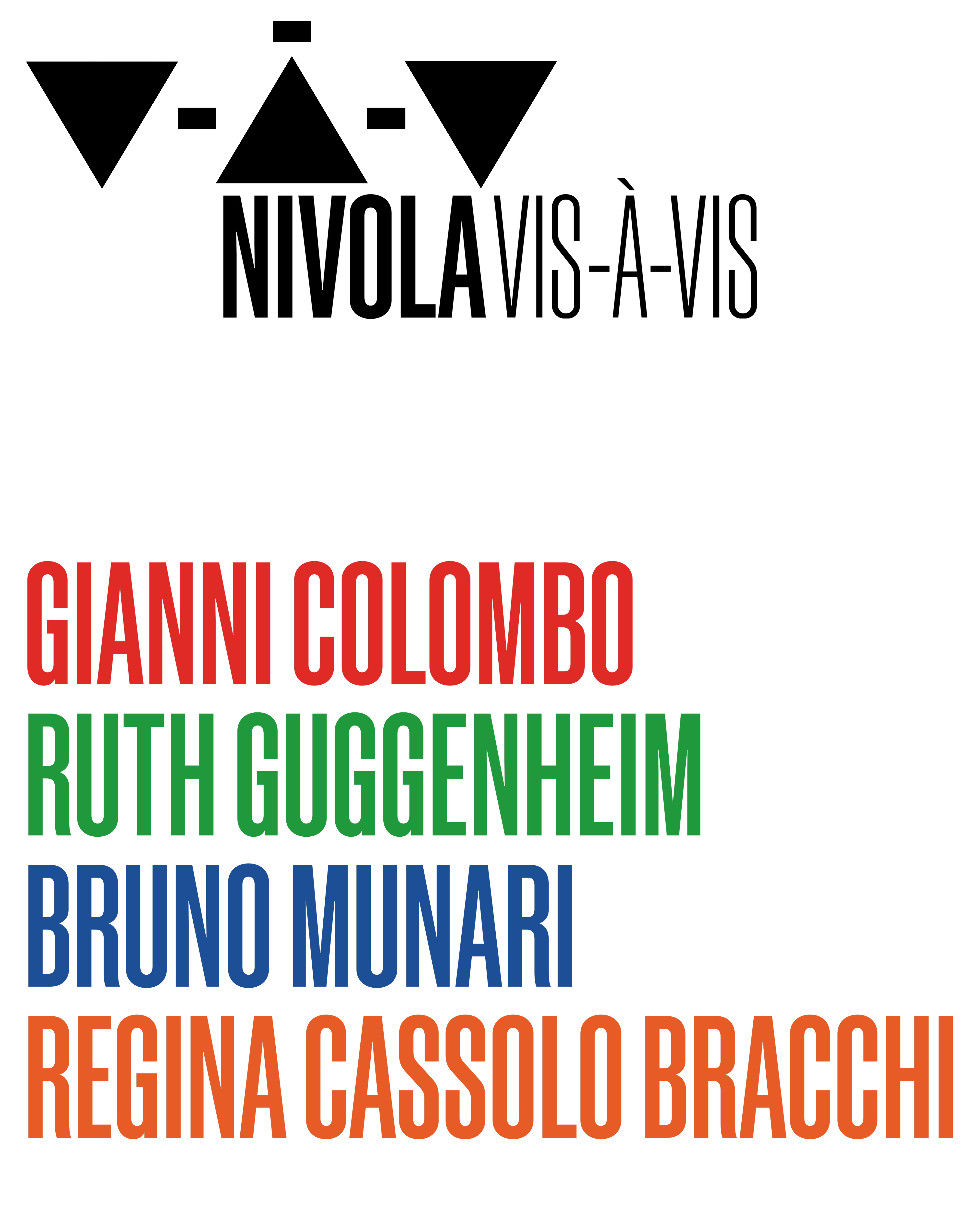
Curated by artistic director Chiara Gatti, with the support of the Scientific Committee, the 2026 summer and autumn programme will place Nivola in dialogue with key figures from the artistic landscape of his time, in a play of gazes suggested by the overall project title, vis-à-vis: intense visual encounters shaped by actual relationships or elective affinities. Here, Nivola’s gaze meets the face of the other; that face reflects personal stories and, at the same time, the person who looks at it, within a logic of reflections that the French philosopher Emmanuel Lévinas called the “epiphany of the face.” The face is the place where the other reveals themself and where, through reciprocal looking, an authentic relationship begins.
“A conversation with Claire Nivola, the artist’s daughter and spokesperson for the family,” says artistic director Chiara Gatti, “gave rise to the idea of working on the elective affinities between Nivola and his contemporaries. It will be essential to orchestrate the new programme around him, given the coincidence with the retrospective devoted to Nivola at Milan’s Triennale this autumn – a meaningful opportunity to propose a harmonious cycle of projects in Orani.”
Nivola is thus placed vis-à-vis with artists who shared his tensions and visions. Against the backdrop of an intuition-rich post-war period, the radical renewal of media – technically but above all expressively – spread among a cohort of “young adventurers,” as Guido Ballo would have called them. Following Fontana, Burri and Tàpies, they manipulated matter through a demiurgic gesture, opening its possibilities towards space and towards a new dimension of space populated by equally new sculptural forms. Abstract art, nuclear art, Spatialism and Concrete Art drew constellations of programmes all marked by an experimental vocation, by the updating of expressive means, and by the spontaneous collaboration of fertile minds active on different fronts, driven to converse with one another in creating – to quote Fontana – the very “luminous and malleable substance” that art is.
Chapter One: ROOMS
Nivola, Colombo and the Space Around Us
Juyly 23 – October 25, 2026
Three rooms, three environments, three places to inhabit with the body. Nivola’s Dream Room, Gianni Colombo’s Elastic Space, and the Room of Memory as a site for activating collective remembrance. Curated by Chiara Gatti and Anna Pirisi, in collaboration with the Gianni Colombo Archive in Milan, the exhibition unfolds in three moments, in tripartite rooms, like the rhythmic units of ancient songs. Starting from shared memory, it develops into a broader reflection on how we inhabit and perceive space. The audience’s sensory experience engages with the artists’ research and, at the same time, with the very space that hosts it.
Scientific rationale: Costantino Nivola’s first environmental study dates to 1968: it is the Model for the Monument to Antonio Gramsci, made in the same year that Gianni Colombo exhibited his Elastic Space at the Venice Biennale.
Thinking about space in terms of passage is what Nivola did in the 1960s through his horizontal monuments, such as the project for Piazza Satta. Connections thus emerge between these masters in the construction and trajectories of light that give space its character. “A light that enters through the window,” Nivola wrote, “to dissolve the persistent darkness / from my temple and prison of intimacy / and my waking dreams.” In Nivola’s aesthetic research, the room takes on the value of a primary measure of space: not a mere architectural environment, but a place built around our presence. Inhabited space becomes an essential core of his thought, a volume conceived to welcome, define and connect human beings with what surrounds them. This idea runs throughout his work, in which architecture, sculpture and everyday life merge into a profoundly human vision of space, later embodied in the “little theatres,” based on modular forms and mathematical and proportional relationships. Beneath the surface, a subtle evocative tension also emerges, capable of calling up an enigmatic and contemplative dimension. The “dream boxes,” the little theatres, therefore explore our descent into an interior, into a perspective that engulfs us, as silent actors in a performance without a script, suspended in a time that betrays its becoming through changing light.
The life-size reconstruction of the Dream Room, in dialogue with Colombo’s Elastic Space, creates a sequence of perceptual experiences between disorientation, shifting coordinates and illusionistic perspectives. In relation to these, the third room has been designed to welcome collective memory through an act of active citizenship, transforming space from a neutral container into a place for thought and a device for gathering memories through different languages, voices, gazes and writing. This is a minimal yet crucial gesture towards forming an archive that will, in every sense, be preserved by the museum. The Lavatoio becomes a place of encounter and exchange, where memory, art and community intertwine in a new shared experience.
Collateral Event
Homage to Grazia Deledda
July 23 – September 20
One hundred years after Grazia Deledda was awarded with the Nobel Prize, the Museum will display, in the rooms of its permanent collection, the bronze sculpture created by Costantino Nivola in the mid-1970s as a tribute to the great writer from Nuoro. The work, on loan from Banco di Sardegna, will be shown alongside the summer exhibitions in the new skylight space.
Chapter Two: FRUITFUL RELATIONSHIPS
Ruth Guggenheim. Light Sculptures
13 November 2026 – 21 March 2027
Coinciding with the major retrospective dedicated to Costantino Nivola by Milan’s Triennale, the museum in Orani will host a project made possible by works that are partly previously unseen and belong to the family, allowing an in-depth exploration of Ruth Guggenheim (born 1917), Costantino Nivola’s wife. Like him, Ruth – trained at the ISIA in Monza – was a visionary experimenter, author of jewel-sculptures born from the craft precision of actual adornments and then projected into the formal dimension of sculpture. The play of references to archaic or vernacular traditions conceals a union of inheritances, between Native American ornaments and Sardinian ritual jewellery, sublimated in abstract composition and in the aesthetics of the little theatre or mobile, informed by pioneering figures such as Louise Nevelson, Marcelle Cahn and Claire Falkenstein. This is an important tribute to a woman of abstraction, linked to Nivola yet independent in her artistic thought. The exhibition will also include a series of portraits of Ruth, in oils and drawings, made by her husband and never before exhibited.
Nivola with Munari and Regina
The Museo Nivola presents a meaningful dialogue, a close encounter between artists who shared an intense experience against the backdrop of one of the most fertile and experimental seasons of post-war Italian art.
Without seeking to provide an exhaustive survey of their careers, the exhibition focuses on a selected group of works and documents that make it possible to revisit the dialogue between the two artists through several current concerns: the dissolution of disciplinary boundaries, the relationship between art and pedagogy, the environmental dimension of the artwork, the dialogue between art and industry, and the creation of new forms of spatial experience. Many of the ideas developed by Munari and Regina between the late 1940s and early 1960s anticipate themes and sensibilities that run through contemporary artistic practices today: the artwork as an open device, lightness as a design strategy, modularity, the mobility of forms, the cross-pollination of languages, and art’s social function. In this respect, the exhibition, curated by Lorenzo Giusti and Chiara Gatti, fits naturally within the context of the Museo Nivola. Not only because of the biographical and cultural convergences that connect the two artists to Costantino Nivola, but because their practices share a vision of art as an experience able to transform the spaces we inhabit and contribute to the construction of a collective sensibility.
Nivola, Munari and Regina took part in the 2nd National Quadriennale of Art in Rome in 1935, a key moment of transition for Italian abstract research. A year later, all three participated with different projects in the International Exhibition of Stage Design at the 6th Milan Triennale of 1936. At the time, Nivola collaborated with Giuseppe Pagano and other masters, producing tempera paintings and murals for the backdrop walls of the exhibition rooms, while Regina exhibited constructions in metal sheets and three-dimensional stage models. The decomposition of form explored by Munari and Regina distinguishes Nivola’s contemporary reliefs, which share with those of his colleagues the practice of building and the discipline of design. Nivola, who founded Harvard University’s Design Workshop in 1954, introducing a teaching approach based on the Bauhaus legacy and free experimentation, had an in-depth understanding of the concept of total space, of aesthetic experience within the places we inhabit, and of the sculptural emotion generated by the “synthesis of the arts.” In 1967, Munari inherited his chair at Harvard, where he was invited to teach for a semester on the same themes.
Despite its intimate scale, the project aims to form part of a reflection on the contemporary meaning of the post-war avant-gardes. Alongside the historical-critical contribution of Nicoletta Boschiero, a member of the museum’s Scientific Committee, voices, thoughts and perspectives will be gathered from curators, museum directors, scholars and artists from different geographical contexts, invited to consider which aspects of these practices remain open, necessary and productive today.
Chapter Three: CORRESPONDENCES
Lacci / Orani 6×6
13 November 2026 – 21 March 2027
In autumn, the Museo Nivola will rethink and present to the public a new installation of its permanent collection which will be partially moved for the major exhibition in tribute to Costantino Nivola scheduled for November at Milan’s Triennale (curated by Cecilia Alemani). It will need to be recalibrated in its layout and content based on the works remaining on site: this will be a valuable opportunity to investigate the holdings kept in storage, highlight works not currently on display, welcome further donations from heirs, and create new connections and narratives among the known works, with unexpected new perspectives. Nearly fifteen years after the collection’s last permanent installation, the museum needs an updated study of its sections. Undertaken by the staff, with the consultancy of architect Alessandro Floris and designer Leonardo Sonnoli, it will offer visitors a different perspective and new opportunities for deeper exploration, examining the subtle transitions between the techniques and languages experimented with by Nivola, including photography. Photography will be at the centre of a collateral section – an exhibition within the exhibition – which, thanks to the collaboration of the Ilisso Archive, will show the public for the first time a rich series of photographs taken by Nivola in the streets of Orani: at the heart of the town, among its people and hidden corners, on the hillside and amid the austere monumentality of the talc quarry.
Collateral Event
Giammarco Cugusi – Portrait of a Community: Orani
Residency and workshop, October-November
The project unfolds in a participatory form. The artist moves through the town, listens to stories, gathers words and opens spaces for discussion. Those who wish to take part are asked to donate a glass from their home: an everyday object imbued with presence, memory and affection.
A word chosen by the person donating the object is engraved on each glass, arising from the meeting and exchange activated through dialogue with the artist. It may be a fragment of the self, a trace that conveys the person’s uniqueness within the community, or a word able to express what the community represents for them. The collected glasses are then arranged on a large communal table. The installation takes shape as a constellation of voices: a silent yet tangible geography in which each element holds a story. The engravings appear as grooves, as traces – almost like a collective vinyl record able to retain and return memory. On the final day, the table is activated through a toast open to everyone. After taking part, each person takes away the glass they used (not their own). In this simple and poetic gesture, the exchange is completed: each person takes care of a fragment of someone else, even without knowing where it came from.
Graphics by Leonardo Sonnoli