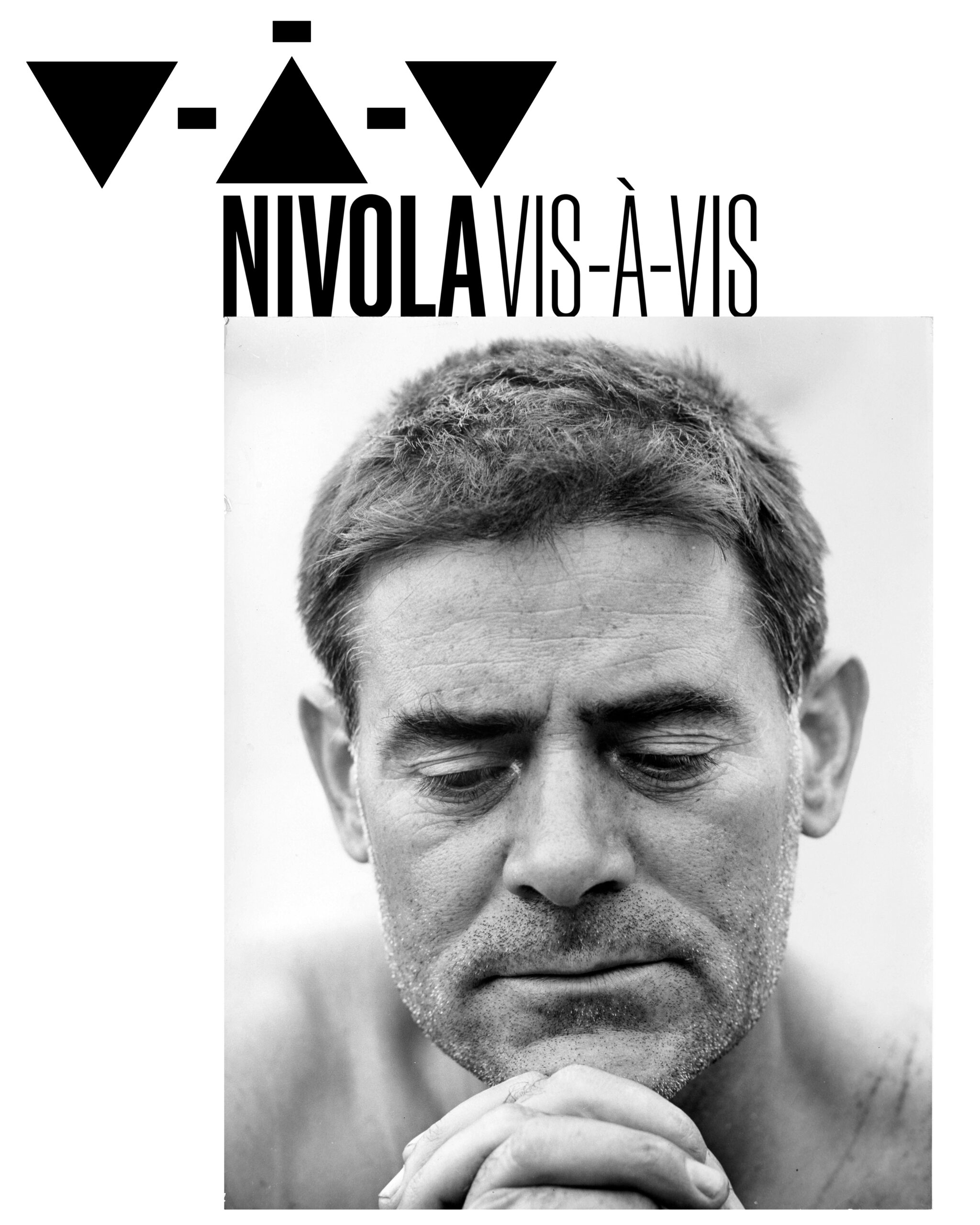
NIVOLA vis-à-vis
The exhibition programme continues with two new exhibitions and a reinstallation of the permanent collection
Ruth Guggenheim Nivola. Sculture leggere
Munari e Regina. Le affinità concrete
Collezione. Capitolo primo. Andando
29 November 2026 – 21 March 2027
At the Museo Nivola in Orani (Nuoro), Nivola vis-à-vis continues: an exhibition programme conceived by director Chiara Gatti to explore previously unexamined aspects of Costantino Nivola’s (1911–1988) artistic research, placing it in dialogue with the era in which he lived, the movements he embraced and the people whose paths crossed his own, whether in reality or in spirit.
Launched in July 2026 with the exhibition Nivola, Colombo and the Space Around, the project continues from 29 November 2026 to 21 March 2027 with two new exhibitions: Ruth Guggenheim Nivola. Sculture leggere and Munari e Regina. Le affinità concrete. Alongside them is a reinstallation of the permanent collection, Collezione. Capitolo primo. Andando, curated by the Museo Nivola team with the advice of architect Alessandro Floris and designer Leonardo Sonnoli.Completing this wide-ranging exhibition programme is the major retrospective Costantino Nivola. Scolpire il vento, curated by Cecilia Alemani and dedicated to the Sardinian artist by Triennale Milano from 11 November 2026 to 14 February 2027, to which the Museo Nivola is contributing a number of important loans.
Ruth Guggenheim Nivola. Sculture leggere
curated by Chiara Gatti
Museo Nivola, 29 November 2026 – 21 March 2027
The Museo Nivola presents an unprecedented exhibition project exploring the work of Ruth Guggenheim (1917–2008), Costantino Nivola’s wife, through works from the collection of the artist’s heirs in Boston.
Ruth Guggenheim was a visionary experimenter who created jewellery-sculptures poised between adornment and work of art. These pieces contain implicit references to ancient traditions, ranging from Greek and Etruscan archaeology to Sardinian ritual jewellery, transformed through abstract composition and the aesthetics of miniature theatre or mobiles, and informed by the work of pioneering figures such as Louise Nevelson, Sophie Taeuber-Arp and Claire Falkenstein.
“With Timeless Pendulum and Zenith Balance, we therefore have the final coordinates that allow us to say that the relationship these sacred implements establish with the sacred is not merely one with myth: they connect to the myth of myths, cosmogony, the creation of the world, the founding of all things,” writes Matteo Meschiari in the exhibition catalogue. “Just as the act of creating the world takes place through the utterance of words for the first time, just as from these words emerge time and space, geography and genealogy, humans and non-humans, animals and plants, plants and landscapes, Ruth Guggenheim’s personal cosmogony generates an entire world, which a few dozen objects, made painstakingly slowly by hand, manage to capture, quite literally, within their intricate structures.”
In addition to the jewellery-sculptures, the exhibition will feature preparatory drawings, notebooks and a series of pencil and charcoal portraits of Guggenheim, together with a painting and a full-length sculpture by Costantino Nivola, neither of which has ever been exhibited before.
The exhibition is thus a tribute to a woman of abstraction, connected to Nivola yet independent in her own artistic thinking.
The exhibition catalogue is published by Allemandi, with texts by Matteo Meschiari, Claire Nivola and Teresa Kittler. Coordination by Anna Pirisi.
Munari e Regina. Le affinità concrete
curated by Lorenzo Giusti and Chiara Gatti
Museo Nivola, 29 November 2026 – 21 March 2027
Bruno Munari (1907–1998) and Regina Cassolo Bracchi (1894–1974) shared an intense creative experience against the backdrop of one of the most fertile and experimental periods in post-war Italian art. The exhibition Munari e Regina. Le affinità concrete explores its key aspects, focusing on a selection of works that invite a fresh reading of the dialogue between the two artists in light of questions that remain relevant today. These include the dissolution of disciplinary boundaries, the relationship between art and education, the environmental dimension of artworks, the link between art and design, and the creation of new ways of experiencing space.
Many of the ideas developed by Munari and Regina between the late 1940s and the early 1960s also anticipated themes and sensibilities found in contemporary artistic practice today: the artwork as an open system, lightness as a design strategy, modularity, the mobility of forms, the crossing of different visual languages and the social function of art.
ogether with Nivola, Munari and Regina took part in the Second Rome Quadriennale in 1935, a key transitional moment for Italian abstract art. A year later, all three participated with different projects in the International Exhibition of Stagecraft held as part of the Sixth Milan Triennale in 1936.
The deconstruction of form explored by Munari and Regina echoes in Nivola’s reliefs of the same period. He shared with his fellow artists both the practice of making and the discipline of design. The Sardinian artist, who founded the Design Workshop at Harvard University in 1954, introducing an approach to teaching based on the Bauhaus legacy and free experimentation, was deeply familiar with the concept of total space, with aesthetic experience within inhabited environments and with the sculptural emotion generated by the “synthesis of the arts”. In 1967 Munari succeeded him in his teaching post at Harvard, where he was invited to lecture on the same themes for a semester.
The exhibition belongs at the Museo Nivola not only because of the biographical and cultural connections linking the two artists to Costantino Nivola, but also because their respective approaches share a vision of art as an experience capable of transforming living spaces and helping to shape a collective sensibility.
Organised in collaboration with Archivio Bruno Munari, Archivio Regina, Archivio Corraini and Repetto Gallery. Catalogue published by Lenz, featuring texts by the curators and a historical-critical contribution by Nicoletta Boschiero, a member of the museum’s Scientific Committee. Coordination by Rosella Sedda.
Collezione. Capitolo primo. Andando
Museo Nivola, 29 November 2026 – 21 March 2027
Following the loan of numerous works from its collection to Triennale Milano for the exhibition Costantino Nivola. Scolpire il vento, the Museo Nivola presents a new installation of its collection, with its layout and content rethought around the works remaining on site, also thanks to the advice of architect Alessandro Floris and graphic designer Leonardo Sonnoli.
This is an opportunity to explore the museum’s holdings in storage, showcase works not currently on display, welcome further donations from the artist’s heirs and create alternative narratives and unexpected lines of enquiry.
In Collezione. Capitolo primo. Andando, the techniques and languages embraced by Nivola unfold along a thread connecting the artist’s different experiments. Photography is among them, at the centre of a complementary section—an exhibition within the exhibition—which, thanks to the collaboration of the Ilisso Archive (with an Ilisso catalogue featuring texts by Anna Pirisi and Antonia Pintori), presents for the first time a substantial series of photographs taken by Nivola in the streets and heart of Orani in the early 1960s, among its inhabitants and hidden corners, its hillside and the austere monumentality of the talc quarry.
The project is an exercise in tactical museography: a temporary, dynamic reinstallation which, rather than simply replacing works on loan, generates new relationships, brings lesser-known works together and restores visibility to parts of the collection previously marginal to the permanent display.
Works by Munari and Regina will also be displayed alongside them in a further dialogue, punctuating the route with an engaging interplay of unexpected juxtapositions.
MUSEO NIVOLA
The Museo Nivola in Orani, in the province of Nuoro, is dedicated to the life and work of Costantino Nivola (Orani, 1911 – East Hampton, 1988). Managed by the foundation bearing his name, it was established in 1995, a few years after the artist’s death, to protect and promote his research and legacy.
Over the years, projects have focused on his work and on contemporary artists whose paths crossed his own, alongside exhibitions and residencies exploring contemporary artistic languages, which continue today to cultivate subtle, meaningful connections with his intellectual legacy.
The museum occupies three main buildings set along the hillside overlooking the town, near the Su Càntaru spring. Its architectural plan was designed by Peter Chermayeff and subsequently developed over time by Umberto Floris and Sebastiano Gaias, Gianfranco Crisci and Alessandro Floris. Conceived both as a monographic museum and as a lively workshop where art, architecture, nature and landscape engage in harmonious dialogue, it plays a crucial role in the study of Nivola and serves a civic purpose by involving local communities in programmes which, true to the artist’s example, encourage participation and activate public space.
The permanent collection, displayed on a rotating basis, comprises hundreds of sculptures, paintings, drawings and numerous examples of the celebrated sandcasts, bearing witness to every phase of his thinking and multidisciplinary experimentation. This work marked an important chapter in modern explorations of the relationship between sculpture, environment and design. Through its ongoing activities, the Museo Nivola supports shared cultural growth and brings to life the history and memory of the surrounding region.
Ruth Guggenheim Nivola. Sculture leggere
curated by Chiara Gatti
Orani (Nuoro), Museo Nivola
29 November 2026 – 21 March 2027
Munari e Regina. Le affinità concrete
curated by Lorenzo Giusti and Chiara Gatti
Orani (Nuoro), Museo Nivola
29 November 2026 – 21 March 2027
Collezione. Capitolo primo. Andando
Orani (NU), Museo Nivola
29 November 2026 – 21 March 2027
Institutional Sponsors
Autonomous Region of Sardinia, Municipality of Orani, Province of Nuoro
Principal Supporter
Fondazione di Sardegna